Thursday, April 12, 2018

A Quiet Place

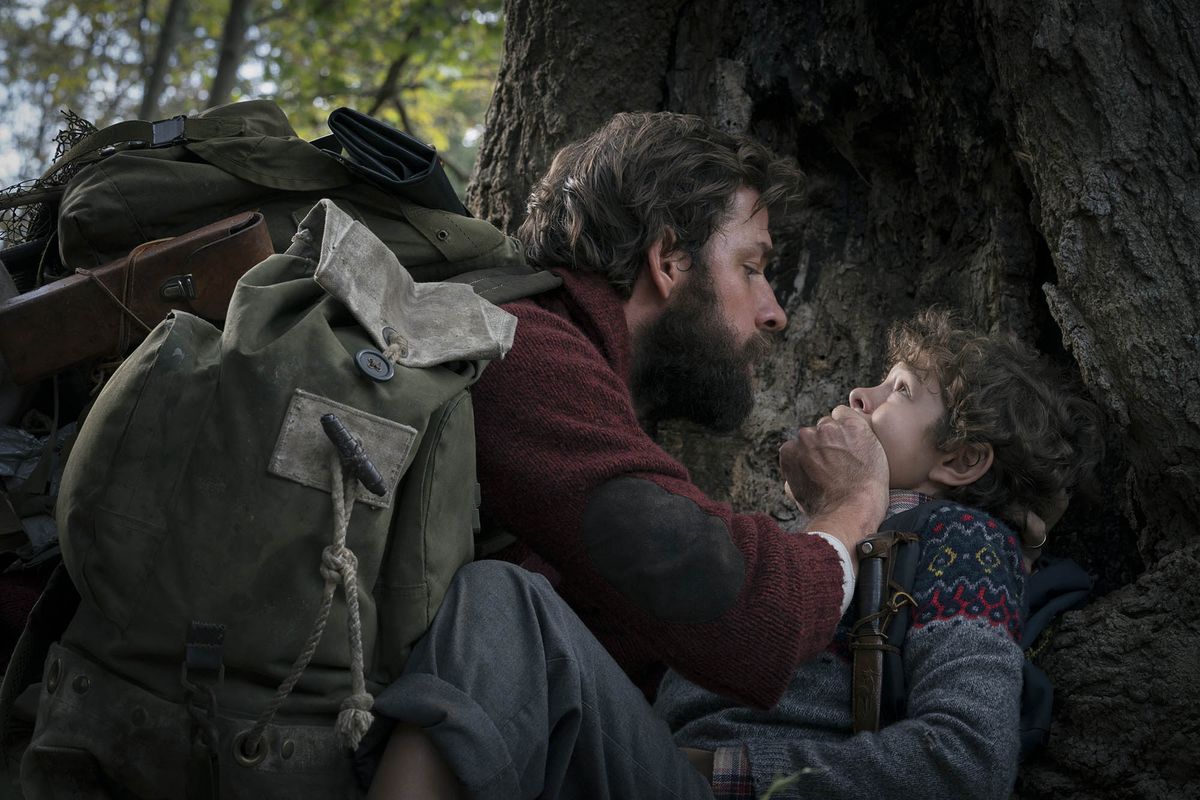
Over the weekend, I saw John Krasinski's latest film, "A Quiet Place". I don't think I've ever written a blog about a horror movie- while I enjoy many older horror films, I rarely rush to the theater to catch the latest one. However, upon hearing about "A Quiet Place" I made sure to see this one opening weekend. I was initially drawn to the film due to the unique premise of it. Most horror movies that are released are centered around paranormal activity, which I find can be pretty redundant and ineffective. To give some context, "A Quiet Place" takes the viewer to a post-apocalyptic world filled with creatures that kill if they detect any sound. Krasinski and Emily Blunt are parents to their three children, who we meet creeping around a store attempting not to make a sound. Their oldest daughter is deaf (the actress who plays her is deaf in real life), which adds a fascinating layer to the story.


There were many elements that set this horror film apart from the rest. One of these elements was the sheer emotion portrayed in the film. Most horror movies primarily focus on one emotion in their characters- fear. This movie really pulled on the viewer's heartstrings, and certainly packed an emotional punch. Your heart will break for these parents as they go to extreme efforts to protect their children in this post-apocalyptic world. Something else that sets this horror movie apart is the incredible attention to detail. Due to the premise of the film, it was essential that Krasinski considered every possible detail, especially when it came to sound.

Since the creatures in the film will kill the characters if they make a single sound, for the most part the film is silent. Unfortunately, we were next to a theater playing an exceptionally loud movie, which was incredibly disruptive. People in the theater were reluctant to eat their popcorn due to the noise it would produce. The movie makes you incredibly aware of your sounds as if you are experiencing what the characters are experiencing. The attention to detail in this movie is truly remarkable. This was essential when making a film that is so focused on sound. For example, the movie opens in an abandoned store where the family attempts to get medicine for their sick son. As the camera pans around the store, it is evident that the shelves are empty, but bags of chips remain- due to the noisiness of the snack. Throughout the entire film, viewers get glimpses similar to this one demonstrating how invested the parents are in protecting their children from these creatures. Another fascinating element to the film is it can't rely on dialogue. This makes every facial expression, gesture, and sign that much more crucial and impactful. Somehow the lack of dialogue allows the viewer to have an even stronger emotional attachment to the characters. It is moving to see how the family members don't need words to communicate their emotions towards one another.


Krasinksi delivered the most effective horror movie since "Get Out". It has had the most success at the box office after "Black Panther". This has been an incredible testament to Krasinksi's achievement with this film. While he's directed two films prior to this one, many people solely know him as Jim in "The Office". I'm certain that this movie will further launch his career and secure his position as a rising Hollywood director and actor. John Krasinski not only directed, produced, and co-wrote the film, but costarred in it with his real-life wife, Emily Blunt. It was really touching seeing the couple portray a married couple on screen. It was evident that they applied elements of their own marriage to their characters. Krasinksi has cited that the film is ultimately about parenthood. Again, the emotional aspects of this film truly separate it from others of this genre. What sets a good horror movie apart from a bad one is the amount of emotional investment a viewer has on the characters. From the very beginning, I was invested in the characters.

I would suggest giving "A Quiet Place" a chance, even if you aren't a horror movie fan. It's definitely more of a thriller. Be prepared to get emotionally invested in the characters. Also be prepared to spend the rest of your day incredibly in tune to the amount of sound your actions generate. I don't think this movie was the best movie I've ever seen, but I really think it was great for the kind of movie it was. Definitely don't discount it as "just another horror movie". John Krasinki certainly deserves a round of applause for pulling this off. Highly recommend if you want a fun scare!


Tuesday, March 6, 2018

The 90th Academy Awards

Hello again, my fellow movie lovers! You know how some people get the post-holiday blues? Well, I get the post-Oscar blues. Every year I look forward to awards season, specifically the Oscars, so naturally I'm sad that it has come to an end for this year! Anyway, I'm going to jump right in to my commentary on this year's Academy Awards!

Before I jump into the nitty gritty, I will say that my overall consensus is that it was a heartfelt and uplifting ceremony, yet the awards themselves were, well, boring.

Jimmy Kimmel hosted for the second year in a row. Clearly his main objective was to ensure the Best Picture-gate of last year didn't repeat itself! I think Kimmel overall did a good job hosting this year's show (personally, I think we should have Tiffany Haddish and Maya Rudolph team up to host next year!). I really enjoyed the opening monologue, paying homage to old Hollywood. His remarks threw some shade at Trump and Weinstein, but weren't overly political. Kimmel also acknowledged last year's debacle in a comedic and tasteful way. He made it clear that new measures were placed to ensure that a mix-up would not repeat itself. I know a lot of people really enjoyed Kimmel's jokes throughout the show- I thought they were fine, nothing out of this world. I think the whole movie-theater-field-trip was slightly unnecessary (if these people were such movie fans, why weren't they watching the Oscars??- that being said I wouldn't say no to a visit from Ansel Elgort). I did enjoy his enticing jet ski prize for the shorted acceptance speech! Another component that I really liked were the montage clips of past winners shown before many of the categories. This definitely added to the length of the show, but it's so important for this show to remind us of the films we love. I really appreciate when the Academy Awards recognize the history of films.


Now onto the awards! My overall opinion is that the winners this year were for the most part exceptionally predictable. I desperately wanted a curveball! All of the acting awards seemed like shoo-ins. Frances McDormand won Best Actress for her performance in "Three Billboards in Ebbing, Missouri". She's taken the lead at previous award shows and most outlets predicted this win. While yes, I do think McDormand did a fantastic job in this role, I think there were other actresses more deserving of this award. I personally would have loved to see this award handed to Margot Robbie for her performance in "I, Tonya" or to Saoirse Ronan in "Lady Bird". I will say that I really respected McDormand's acceptance speech. She called for all the nominated women to stand up. She reminded us all of the importance of female representation in film. Gary Oldman won Best Actor for his portrayal of Winston Churchill in "Darkest Hour". I certainly think Oldman earned this award. He was entirely unrecognizable as Winston Churchill and delivered an extraordinary performance. Again, everyone knew he was going to win. I am glad he did, but I secretly was rooting for Timothee Chalamet in "Call Me By Your Name". It would have been great to see a young actor, such as Chalamet or Ronan, get this sort of recognition for their sheer talent at such young ages. Allison Janney won Best Supporting Actress for her role in "I, Tonya". While this may have been predicted by the masses as well, I wouldn't want this award going to anyone else. Janney simply was incredible as the villain in "I, Tonya". She nailed the complicated role of Tonya Harding's psychologically and physically abusive mother. Janney nailed this role. She also nailed her acceptance speech. She started off jokingly claiming to have "done it all by herself". While she admitted that wasn't entirely true, it is irrefutable that Janney deserved this award this year. Finally, we saw Sam Rockwell take home the Oscar for Best Supporting Actor. Again, no surprises here. He's won other awards for this role. I was convinced he'd win this leading up to the show. He was great in his role, but I think all the nominees were fairly equally deserving of this award.


While the acting awards this year were fairly predictable, Best Director and Best Picture were really a mystery. Guillermo del Toro certainly had a fantastic night, as he won Best Director, and his film "The Shape of Water" won Best Picture. There's been a fair amount of backlash about both of these wins. Starting with Best Director, I personally was rooting for Greta Gerwig. Her nomination for directing "Lady Bird" was revolutionary. This was her first time directing a film by herself, and she was only the fifth woman to ever be nominated in this category. I know a lot of people were hoping Jordan Peele would win for his film "Get Out". He also made incredible strides, as he was the only  person to be nominated the same year for Best Picture, Best Director, and Best Original Screenplay. While he didn't get Best Director, he was the first black man to win Best Original Screenplay. While I am sad that Gerwig didn't win Best Actor, I was happy to see del Toro win. I've always been a fan of his work. His mind functions like no other. He created this magical world in "The Shape of Water". It's hard to believe that a film about a woman who falls in love with a fish won the biggest film award of the year. But the film is so much more than that! It's a historical drama, romance, and fantasy wrapped into one in the most beautiful way. Its biggest competitors for Best Picture were "Get Out" and "Three Billboards Outside Ebbing, Missouri". I am personally content with its victory over the competitors. It's just so original and expresses the sheer creativity possible in film. I liked that they brought Faye Dunaway and Warren Beatty back to deliver the results of Best Picture. After all, the mix-up last year was not their fault! My final quick note on the actual awards- Dunkirk took home three technical awards, which made me happy! I adore Dunkirk and didn't expect it to win big, so I'm glad it didn't go unnoticed.


Anyway, it was a fairly unremarkable year at the Academy Awards. Regardless,  I had a marvelous time watching all of the nominated films this year. I am continuously amazed by the power of film. The art presented this year was diverse, imaginative, and inspiring. I am excited to see what the next year in film brings. Until next year, it's been a blast taking in the magic of the Academy Awards.

Monday, February 5, 2018

Call Me By Your Name

Last week, Oscar nominations were announced. This has always been a sacred day for me. Some people look forward for their Amazon Prime orders to ship; others eagerly await Christmas morning. Me, well I can't wait for Oscar nomination day. The most exciting part about it is that I've already seen eight out of the nine nominations for Best Picture! That being said, I have a lot of thoughts on all of these films and am eager to share them.

Since I wrote a raving review on Greta Gerwig's film, "Lady Bird," I thought it would be fitting to review another coming-of-age movie next- "Call Me By Your Name." 2018 is proving to be a great year for young actors. Saoirse Ronan blew me away with her performance in "Lady Bird." One of her costars, Timothee Chalamet, starred in Italian filmmaker Luca Guadagnino's "Call Me By Your Name," another coming-of-age film. At the young ages of 22 (Chalamet) and 23 (Ronan), these two young stars could make history with their nominations for Best Actor and Best Actress in their respective films.

Chalamet shines in his performance as Elio Perlman, a 17-year-old Italian American spending his summer reading and playing music in his family's villa. Things begin to shift when Oliver (Armie Hammer), an American student studying under Elio's father, arrives. Despite their age difference, the two develop a complex romantic relationship. Since love stories are told in film time and time again, it can be hard for filmmakers to break the mold and showcase new stories. This film succeeds immensely in doing so, telling the story of a forbidden love between two men of different ages in 1980s Italy.

The strongest component of this film is the acting, lead by the young but mighty Chalamet. I can confidently assess that his performance as Elio was one of the most impressive performances I have seen all year. Elio is a young kid with an exceptionally creative mind, occupying his mundane summer days with music and literature. While he can be confident and even arrogant at times, he is confused by his sexuality. He continuously flirts with a girl from his village, yet finds himself attracted to Oliver. Chalamet invites the audience to empathize with Elio's feelings of melancholy, heartache, passion, confusion, and curiosity.

Chalamet shares the screen with Hammer, playing Oliver, an exceptionally arrogant American who makes the Italian girls swoon. He may wear some very short shorts, but he does not wear his heart on his sleeve. While the audience sees Elio eyeing Oliver from the get-go, Oliver's feelings for Elio are initially more discreet. This film accomplishes expressing the tension, confusion, and complication in the relationship between Elio and Oliver. Their relationship allows for both Elio and Oliver to express vulnerability, which is rarely seen unless the two of them are together. Elio can be cold and distant, while Oliver can be callous and selfish. The only time either character expresses any sense of sensitivity are when they are together. While this vulnerability is one of the beautiful characteristics of their relationship, the strain placed on this relationship is evident as well. There is continuous palpable tension between Oliver and Elio. This results from a number of things- their personal sexual discoveries, the time restraint placed on their relationship, and the "forbiddances" of their affair. The overt sexuality of this film also sets it apart from others. Rather than being obscene and over the top, the intimate moments between Oliver and Elio further illustrate the complexity of their relationship as well as their independent internal turmoil.

In addition to painting the portrait of a romantic relationship between the two main characters, "Call Me By Your Name" also captures a fascinating European family dynamic. Elio's family seamlessly switches between French, Italian, and English in their conversations. Elio's parents seem to have a very understanding and communicative relationship (until the father ultimately reveals that he feels differently at the end of the film). While Elio never directly confirms his homosexuality with his parents, they've picked up on clues throughout the course of the summer and are extremely accepting of their son. Considering that this film takes place in the 1980s, a time where homosexuality was not widely socially accepted, Elio's support from his parents is a key factor.

Between the strong acting performances, the fascinating subject matter, and the stunning cinematography presented in "Call Me By Your Name" it is no surprise to me that this film was nominated for Best Picture. I can't wait to watch Timothee Chalamet's career progress, and am certainly rooting for this film this awards season.

Tuesday, January 9, 2018

The Disaster Artist

Bear with me for the following sentence: "The Disaster Artist" was the best movie ever made about the making of the best worst movie ever made. For anyone who is unfamiliar with the premise of "The Disaster Artist," it is crucial to provide some background information on the film.

First of all, James Franco directed and starred in "The Disaster Artist." Anyone who knows me knows I've been a huge Franco fan for years. I thought he was absolutely extraordinary in "127 Hours." His talent, in my opinion, is irrefutable. Franco pursued 4 graduate degrees simultaneously. He's worked on dozens of movies. He taught film, wrote a novel... the list goes on and on. To cap it all off, this past Sunday he won a Golden Globe for his portrayal of Tommy Wiseau.


The film the "Disaster Artist" can certainly be tricky for many people to wrap their heads around- wait, so it's a movie about a book about a movie? Yeah, it's a little complicated. Let me break it down for you. In 2003, a movie came out titled "The Room," which is famously known as the worst movie ever made. This movie was directed and created by the enigmatic Tommy Wiseau, a man whose age and birth place have remained a mystery to the public for over a decade. To truly get a sense of "The Room," you have to watch it. There are no words to explain this film. Over the years, it's obtained a cult following. A few months ago I went to a screening of "The Room" in Los Angeles and it was quite an experience. Audience participation has become a critical component of viewing this film. To give an example, the picture frames seen in "The Room" all contain pictures of spoons. Naturally, every time one of these frames pops up on screen, the entire audience pelts plastic spoons at the screen. I very strongly recommend experiencing this for yourself.

In 2013, Greg Sestero, one of the stars of "The Room," released a book called "The Disaster Artist." This nonfiction book exposed every odd detail of film production and every unbelievable quirk of Tommy. In addition to documenting production of "The Room," this book also told the story of Greg and Tommy's intricate friendship. Naturally, as a big fan of "The Room," I've read this book and it was honestly one of the most endearing stories of friendship I've ever come across.

Last year, it was revealed that James Franco was turning this book into a movie. Clearly, as a major fan of Franco AND "The Room," my calendar was marked for a full year. I honestly cannot remember the last time I was quite so excited for a movie to come out. As I mentioned earlier, I had the wonderful opportunity to live in Los Angeles for a few months. While I was there, I went to an event to hear James Franco, and his brother, Dave, talk about working on "The Disaster Artist." He revealed many fascinating details about Tommy and what it was like to work with him. It was clear that this project meant so much to him. So many actors in Hollywood got excited by this project, so there are a ton of really wonderful people in the film. Through hearing him speak, and certainly through watching the movie, it was evident that this was truly a passion project for Franco.

Now, finally getting to the film itself (thanks for hanging in there), "The Disaster Artist" was well worth the wait. It was so heartwarming and so funny. Since I read the book and every single interview I could get my hands on about the movie, no parts of the film really came as much of a surprise to me. As James Franco himself has said, it's truly a film about dreamers and friendship. I could really tell that the character of Tommy resonated with Franco. This is something he addressed when I heard him speak. As an actor, he understands the struggles of following your dreams in Hollywood. While it is truly compelling to watch Tommy's ambition unravel into failures and successes on screen, I thought it was even more impactful to observe the friendship between Tommy and his best friend and costar, Greg. Dave Franco played the role of Greg- at first I was a little skeptical because the younger Franco brother hasn't had the most experience, but he really pulled it off. I think the two brothers portraying complicated best friends on screen was a great tactic. It made the relationship feel all the more genuine. Between the story of a friendship and the story of chasing your dreams, this film is really able to draw in an audience.


James Franco is really unbelievable as Tommy Wiseau in this film. Tommy is a very distinctive guy. He has an accent sounds Eastern European, yet the man has claimed he's from New Orleans. Tommy has jet-black dyed hair, regularly wears several belts at once, and has an infamous lazy eye. Franco seamlessly stepped into this role and is entirely unrecognizable as Tommy. He even directed in character. Tommy is without a doubt a complex man, and Franco really did a stellar job capturing his character.

I just graduated from college with a degree in marketing, so sometimes in my blogs I like to interject with a little commentary on the marketing of the films I've seen. Back in the day, to market "The Room," Tommy Wiseau rented out a billboard in Los Angeles for 6 month. This menacing billboard featured a massive photo of Tommy, which looked more like a mugshot than a headshot. He unbelievably put his own phone number on this billboard, encouraging people to contact him. To market "The Disaster Artist," James Franco recreated this billboard and added a number that would connect a caller to either himself of Tommy. This is a brilliant way to create buzz and really excite fans of "The Room." In addition to the billboard, James Franco did a lot of press interviews and his excitement is so evident in all of the press coverage. Posters for the film were released with really great shots of Franco as Tommy. The marketing team created a website called "Tommy's Planet," which not only strategically references the film, but served as a functional and hysterical website for fans to use. The social media strategies were out of this world as well (some could say they are also on Tommy's planet). For example, there were several Facebook videos posted documenting phone calls with Tommy (re: the infamous billboard). Whoever worked on this campaign should be so proud!

While I ultimately recommend seeing "The Disaster Artist" regardless, I really recommend watching "The Room" and then watching "The Disaster Artist." Both are worth the watch! At the end of "The Disaster Artist" there is a side by side comparison of scenes from each of the movies, and the recreation of these scenes is extraordinary. It's such a fun movie to watch, and there is so much heart to it. The passion behind this film is truly apparent across the board, which is why I think this film was ultimately successful.

Monday, November 20, 2017

Lady Bird

Hello again to my fellow movie lovers! I apologize for being MIA! I am finishing up my last semester of college in the City of Angels, taking in everything I can about what it means to work in the entertainment business! While I've been busy, one thing I'm never to busy for is going to the movies. The last movie I saw was "Lady Bird" on its premiere night. This movie was exactly what I needed right now- I am at a transition in my life with graduating from college just around the corner- these themes of change are present in "Lady Bird" as well.


Honestly, when I first saw the trailer to "Lady Bird" I thought it looked good but not great. I debated whether I wanted to spend nearly $20 (because yes tickets in LA are that expensive) to see this film. That being said, I was beyond thrilled with my decision to see it in theaters. While I'd recommend seeing this film at any cost, I'd really recommend seeing it with your mom if you can! The movie is centered around a coming-of-age theme and a relationship between a rebellious teenager and her mother. I certainly wish I saw it with my mom!

"Lady Bird" is honestly one of the most flawless films I've seen in a long time. It would be so easy make another generic coming-of-age movie, but "Lady Bird" is so much more than that. To give you some context, the title character, Lady Bird, lives with her family in Northern California. She is in the midst of applying to colleges, and desperately wants to move to the Northeast upon graduation. The film focuses on the awkwardness of one's teenage years and the challenges one faces upon the end of adolescence.

Every single aspect of the film to me was perfection. The script was witty, the cinematography was sharp, the acting was superb. Saoirse Ronan played Lady Bird- two years ago she starred in "Brooklyn" in an entirely different role, so her acting ability was very evident in this film. The film brilliantly married humor and emotion, which is a lofty accomplishment for any film. The audience in the theater was continuously cracking up, and there were moments where I'm sure people were rummaging through their purses for tissues as well. Unless you are some force against nature, anyone and everyone can relate to the struggles of adolescence- finding yourself and your place in the world, while still living in the town you grew up in under your parents' roof. There were so many points in the film where I, among many others, I'm sure, thought "That's me! I've been through that". The themes of self-identification, finding one's home, the evolution of a family dynamic, and many more allow "Lady Bird" to be one of the most emotionally satisfying films of the year. It is the perfect balance of emotional and humorous.

Throughout the entire film I was entertained. When I wasn't laughing, I was connecting to the emotions of the characters. As I previously mentioned, the relationship between the mother and the daughter is a major component of the film. Something that I really liked was that those two characters were so similar- strong-willed, independent, fierce- yet they clashed and fought constantly. I think a lot of mother and daughter relationships work that way. When you're young, sometimes it's easier to rebel when you connect so strongly to a parent. In a way, you interpret this as them interrupting your path to self-identification. This was brilliantly crafted in "Lady Bird".

I genuinely think there is something for everyone in this film. I went to see it with two of my friends and we all came out with different parts of the film that strongly resonated with us. I don't want to spoil it, but there was one particularly emotional scene between the mother and daughter following a fight- this definitely made me think of me and my mom when I was in high school. For another friend, the notion of moving from a suburb to a big city was a strong point of connection. Regardless of who you are, I think you'd find a point of connection in "Lady Bird".

In conclusion, this film is delightful and insightful. Anyone can really connect with it, and I strongly urge you all to see it in theaters while you still can! I've noticed that many of my favorite movies don't necessarily have a complex plot- "Lady Bird" definitely follows suit. This movie presents the audience with regular people in everyday situations- and ensures that these are the characters we can relate to. Not to be corny, but you will laugh and you will cry. Don't believe me? See for yourself!

Sunday, July 23, 2017

Dunkirk

"Dunkirk," Christopher Nolan's latest biographical film, opened this weekend, polarizing audiences on their opinions. Critics are raving about this summer war movie, however I've heard countless attendees roll their eyes at the reviews, finding the film dreadful. I've always been a fan of Nolan's work ("The Dark Knight," "Inception," "The Prestige) so "Dunkirk" was a natural addition to my ongoing watch list. I've also always been drawn to period films, especially ones centered around war. I was initially surprised that Nolan took on this project, as none of his past films have been centered around a true historical event. When the trailer was launched, I thought it looked pretty good but thought it wouldn't be anything spectacular. Seeing the film today, however, I was very pleasantly surprised with the movie.

The film's plot is centered around three different storylines- one for the air force, one for the military, and one for the navy. This in itself is brilliantly done because these stories switch off seamlessly, yet depict different spans of time. While the plot wasn't exceptionally complex, the attention time frames made this film unlike any other. The events on the beach take place over a week, the events in the sea span a day, and the events in the sky span only one hour. As the tension in the film builds, there are shorter cuts between the different storylines, heightening the excitement of the film. Most war films I've seen tend to fixate on a few specific characters, draw a storyline around them, and create an emotional investment in their outcomes. In "Dunkirk" the audience is introduced to many characters. While some have more screen time than others, the decision to incorporate many characters allows for the audience to get a better sense of just how many lives were effected by Dunkirk itself, let alone World War II. I definitely don't think "Dunkirk" was the most emotionally devastating war movie I've ever seen (in fact I may have found it slightly surprisingly unemotional) I think the immense attention to detail makes up for that. It is evident throughout the entirety of the film that every little detail was thoroughly thought through. For example, Nolan wanted to use as little CGI as possible, so he used real naval destroyers instead.

While I don't think there were necessarily any standout performances from the actors, I thought everyone performed well. Nolan intentionally cast a lot of young, relatively unknown (with the exception of Harry Styles) actors because soldiers at Dunkirk tended to be young and inexperienced. There is very little dialogue in the film, yet the audience can sense the feelings of isolation and despair, demonstrating strong performances. It was a great experience to watch this film in the theater. It is action packed and made for a big screen. It is also so beautiful- from the cinematography to the coloring, and everything in between. It reached new levels of complexity and technique, and will likely be the film to most impress me this summer. See it in the theaters while you can, it is worthy of the theater experience!

Tuesday, June 13, 2017

The Actor Profile Series: Robert De Niro

In typical fashion, I give feedback on particular films in my blogs. However, I think it's also critical to appreciate the work of the people starring in these films. These are the people that bring life to the characters written on paper. They are the ones that invite an audience to join them in a different world for a couple of hours. They allow strangers across the world to form emotional connections to their characters. That being said, actors do not always do their work effectively. But there are some that truly stand out.

The first edition of my actor profile series is dedicated to the one, the only, a Mr. Robert De Niro. It is no secret that Martin Scorsese is one of my all-time favorite directors, but where would he be without his leading man De Niro? (Fun fact, the honest answer is not good- De Niro convinced Scorsese to kick his drug addiction by bringing him a new movie idea- "Raging Bull- when he was at his lowest). De Niro is a New York man through and through, which shows, since his works primarily takes place in NYC. He left traditional school at the age of 16 to attend an acting school.  Though I wish with all my heart I could say I've seen every De Niro film, this is no easy task, considering the man has credit in over 100 films. However, there are some standout De Niro films that truly showcase his sheer talent:

The first on the list is the 1973 Scorsese classic, "Mean Streets".


In this film, we meet De Niro as mobster Johnny Boy, who is trying to move up the mafia ladder in New York. This movie is brilliantly done- it goes so much deeper than simply being a crime film about gangsters. It showcases a major pressure placed on people by the Catholic church- the notion of sin. In this time period, many people were placed under a great burden, continuously worrying about sinning, which would result in an eternity in flames- sounds like enough to drive anyone crazy. The eternal flames of hell are symbolically apparent throughout the entirety of the film as the color red. All scenes shot in the bar have a clear red lighting, signifying guilt. The tone of the movie is clear straight from the beginning, where we hear a voiceover from Scorsese say "You don’t make up for your sins in church. You do it in the streets. You do it at home. All the rest is BS and you know it.” While De Niro does not play the main character of the film, he gives an outstanding performance as an incautious hustler who is always in debt. He's a jokester in the film, blissfully ignoring the potential consequences of sin that haunt the other characters. The first action his character performs is blowing up a mailbox. Moviegoers have grown accustomed to big-budget gangster films from high-up mobsters, so it was refreshing to see a gangster movie that seems more grounded in reality. It is evident even in this early film that De Niro commits himself to fully embracing his role. His complete transformations are even more evident when you view multiple De Niro films, particularly in his collaborations with Scorsese. His character, Johnny Boy, works in great juxtaposition to Harvey Keitel as the lead. Honestly, I'd be much less invested in this movie if it weren't for De Niro's performance. He gives a great spirit to the film. This movie is exceptionally done but certainly feels dated- I can certainly imagine it packing a punch when it was first released. It is definitely the springboard into the wonders of De Niro's career. 


Next up is Taxi Driver, one of my all-time favorite films. This is also my favorite role for De Niro. In this movie De Niro stars as Travis Bickle, a psychotic (you guessed it-) taxi driver. Bickle is a Vietnam veteran turned paranoid insomniac, and this film brilliantly shows the mental effects war had on veterans. We see his madness rise along with the temperature in this 1970s New York summer.  Travis frequents Times Square and 42nd Street to observe the hookers, pimps, and other "street freaks" that he becomes fixated on. In an effort not to spoil the film, I'll just say that De Niro's performance allows for a psychological buildup that leads to an urban nightmare. De Niro casts a dark smile into the camera, not dislike Heath Ledger's expressions as the Joker in "The Dark Knight". Scorsese has a knack for subtly showcasing emotions, and this is most evident in the film "Taxi Driver". The emotional buildup in De Niro's character is one of the best collaborations between Scorsese and De Niro. De Niro's iconic line in the film is "You talkin' to me?"- who would've guessed that this was improvised! If that doesn't demonstrate De Niro's brilliance I don't know what will. This movie stands the test of time and shows excellence in every division. De Niro's performance raises its mastery to a new level.


Since I was a kid I've always had an affinity for boxing films, oddly enough. Combine De Niro, Scorsese, and boxing, and I'm sold. "Raging Bull", while not commercially successful upon its release, goes down as a classic in the books. This 1980 film depicts the true story of middleweight boxer Jake LaMotta. Once again, beneath a fabulous plot Scorsese skillfully portrays the emotional and psychological confusion of his character. Scorsese is so gifted, but I'll save that analysis for another time. If there is one word to describe De Niro as LaMotta, it would be tumultuous, or, well, raging. The film's title serves as a double entendre, crediting LaMotta's boxing name, as well as the emotional aggression that built up inside him throughout his career. There are many parallels between "Raging Bull" and "Taxi Driver".  La Motta's rage is obviously expressed in the boxing ring, but is most evident through his jealousy surrounding his wife. LaMotta convinces himself that his wife is cheating on him, although there is no evidence demonstrating so. There are so many great components of the film that I can analyze, such as the effects and tactics used to film the fight scenes, but once again, it is De Niro's performance that blows this film out of the water. De Niro gained a significant amount of weight to portray the older LaMotta- so much so that Scorsese forced him to stop since he was concerned about his health. Time and time again, De Niro commits himself to his role, changing his entire mental processes during filming. This film, in classical Scorsese fashion, takes one subject and uses it as a backdrop to brilliantly expose the mental breakdown of the lead. I'd suggest a back-to-back "Taxi Driver" and "Raging Bull" viewing for optimal Scorsese-De Niro glory.


The next film is "The Deer Hunter" from 1978. This provided a unique role for De Niro- no Scorsese, no New York, no gangs. However, once again we see the emotional turmoil of his character unravel before our eyes. This film also demonstrates the emotional impact of the Vietnam War. De Niro plays Michael, who leaves his job at a steel mill to serve in the war. He and his two friends are often seen playing Russian Roulette, which serves as the ultimate symbol of the film. It represents the suddenness of US involvement in the Vietnam war, and the randomness of the epic violence. De Niro is the leading man, ushering his friends through the horrific scenes they find themselves in in Vietnam. The true emotional impact is evident when De Niro goes home, and has great difficulty being welcomed as a war hero. I do not think this is the MOST spectacular performance of De Niro's career, however De Niro still demonstrates his mastery of subtleties. I can only imagine the reactions people had when this film was initially released- like salt in an open wound.


Finally, we'll look at De Niro in a classic role- a Scorsese-crafted mobster. "Goodfellas," from 1990, is a classic crime film that I always come back to. This is my favorite, and in my opinion the best, of all crime movies I've come across. This movie really highlights the finesse of mob life in New York. In the past, we've seen De Niro embrace gritty lower-level mobsters. This grit is shined up like a new penny. This movie tells the true story of mobster and FBI informant Henry Hill. De Niro plays his mentor, Jimmy. While he doesn't have the leading role, his character adds a nice flavor to the film. In the past, we've seen De Niro's mobster films project guilt ("Mean Streets"), but "Goodfellas" sheds a new light on mob life. Rather than Catholic guilt, the sin of this film is betrayal. Its about the emphasis and impact of loyalty in gangs. It shows the complete and utter absorption into mob life. I watched this film immediately after viewing "Mean Streets" and the juxtaposition baffled me. Before going into it, I expected to watch essentially the same film made 20 years apart. The incredible difference in theme once again demonstrates the brilliance of Scorsese, and well as the acting ability of De Niro.

Long live the De Niro and Scorsese brotherhood.